

Youth work is built on relationships. Every day, youth workers listen, encourage, motivate and support young people facing different challenges. But who supports the people who are there for others?
Across Europe, the mental well-being of youth workers is becoming an increasingly important part of the conversation about sustainable and high-quality youth work. Youth professionals often work in emotionally demanding environments, support vulnerable groups and face pressure that can affect their own well-being, motivation and work-life balance. The European youth sector is increasingly recognising that supporting young people also means creating conditions in which youth workers themselves can feel supported.
When youth workers start talking, something changes
This is one of the most important lessons we are seeing through the Y-CARE project.
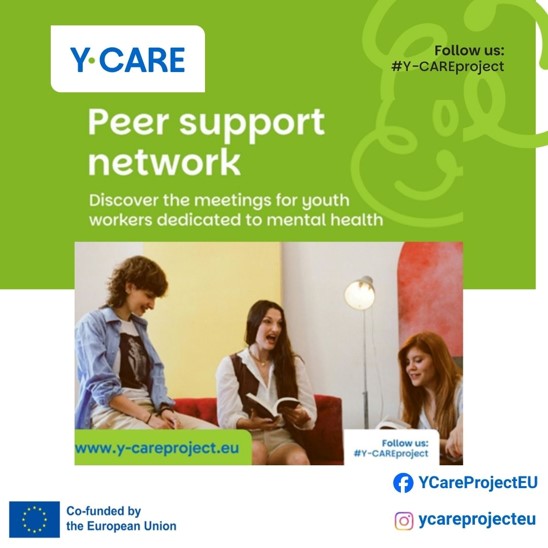
During our events, interviews, focus groups, reflection activities and Peer Support Network meetings, youth workers have been given something that is sometimes missing from everyday professional life: a safe space to talk about themselves.
And when this space is created, people open up.
They talk about moments when their work becomes emotionally demanding. They share experiences of stress, tiredness and uncertainty. They speak about the difficulty of maintaining boundaries between professional responsibilities and personal life. But they also talk about what gives them energy: meaningful relationships, supportive colleagues, positive feedback, learning, creativity and the feeling that their work makes a difference.
These conversations remind us that talking about mental well-being does not have to begin with a problem. It can begin with connection.
From individual challenges to collective support
The Y-CARE project has been exploring the well-being of youth workers through a combination of research and direct engagement with professionals across Europe. The project’s transnational research included a well-being survey, reflection roundtables and focus groups involving more than 120 youth workers and other professionals from six European countries.
The findings underline the importance of factors such as work-life balance, organisational support, resilience and peer relationships.
This is why Peer Support Networks are such an important part of Y-CARE.
The networks create regular opportunities for youth workers and other professionals to meet, reflect on their experiences, exchange practical solutions and simply listen to one another. The aim is not to provide all the answers, but to create an environment where people do not have to face professional challenges alone.
As the Y-CARE training programme highlights, effective peer support is built on trust, confidentiality, healthy boundaries and reciprocity. It can contribute to reducing stress, preventing burnout and strengthening emotional resilience.
Well-being is also a professional strength
Taking care of mental well-being is sometimes mistakenly seen as something separate from professional development. In youth work, the opposite may be true.
Being able to recognise our own emotions, understand our limits, ask for support and reflect on difficult experiences can help us remain present and effective in our work with young people.
As one of the key ideas behind the Y-CARE approach suggests:
“You cannot pour from an empty cup – caring for others also means learning to care for yourself.”
For us, this is not about striving for a perfect balance or never experiencing stress. It is about developing a culture in which it is normal to say “I need a moment,” “This was difficult,” “Can we talk about it?” or simply “How are you doing?”
A European community that listens
The experiences shared during Y-CARE activities show that youth workers across Europe may work in different organisations and cultural contexts, but many of the emotions and challenges they encounter are remarkably similar.
At the same time, these conversations reveal something equally important: there is a strong willingness to learn from one another and build supportive professional communities.
Y-CARE is contributing to this process by combining research, training, peer support, storytelling, reflection and digital learning opportunities. The project’s Peer Support Network Groups are being established in partner countries to provide accessible spaces for professionals to exchange experiences and strengthen resilience together.
The message we are hearing is therefore not only about stress or burnout.
It is also about connection, openness, resilience and hope.
Because when youth workers have space to pause, reflect and talk, they can discover that they are not alone. And when professionals support one another, they create stronger foundations for supporting young people.
The future of youth work starts with people
Mental well-being should not be treated as an additional topic in youth work. It is part of creating sustainable organisations, healthy teams and meaningful relationships with young people.
The European youth sector is already moving in this direction, with growing attention to the competences, support systems and working conditions of professionals who work with young people.
Through Y-CARE, we want to continue creating spaces where youth workers can speak openly, listen to each other and learn together.
Because sometimes the most powerful form of support is surprisingly simple: a safe space, a listening ear, and the knowledge that you are not alone.
And perhaps this is where real resilience begins.
